


Heraldic Emblem of the Army Parks Service
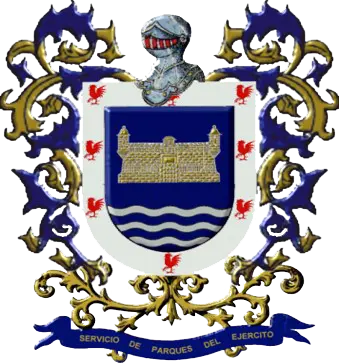
General Description
In accordance with heraldic rules, the arms of an institution consist of the complete set of its blazons and external ornaments, assembled within a coat of arms.
Following this principle, a coat of arms has been designed to represent the hierarchy and rich tradition of logistics, as embodied by the Army Parks Service. Its shape corresponds to the oldest shields of Iberian tradition: rectangular, with height greater than width, and a rounded lower edge forming an arch.
The presence of a helmet stands out as a traditional symbol identifying men-at-arms and, in this case, reaffirming the concept of the superiority of the human being and its values over other elements of the military art. The subsequent design is defined as follows:
Helmet and heraldic ornaments
The helmet appears in profile facing dexter (right side of the shield) above the chief or upper part of the shield, and conforms to the internationally established standard for Military Units, being silver (white), with a grid of five studded bars outlined in gold (yellow), corresponding to those who have military jurisdiction over other Units (Army Colonels use a Baron's helmet as their emblem).
The profile position also indicates subordination and professional dedication to military service.
The lambrequins, or external ornaments shaped like leaves or fabrics, that frame the shield originate from the cloaks or protective garments worn by ancient warriors to shield themselves from the heat of the sun and the dampness of dew and rain. These garments were a source of pride as they fluttered in the wind when they went into battle.
Generally, their color is the same as the field of the shield, unless they correspond to particular colors used during specific campaigns. The colors gold (yellow) and azure (blue) come from the field of the shield and constitute the ornaments of this Service.
Gold represents nobility and constancy, virtues of this Service in fulfilling its duties, and azure (blue) represents the landscape surrounding its area of operation: the sky and the sea.
Coat of Arms
A simple design of long Iberian tradition has been adopted. The shape of the traditional Iberian shield is defined by its proportions, known as latitude and longitude, measured vertically and horizontally, respectively, in a ratio of 6:5, with a rounded lower edge.
Blazon
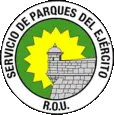
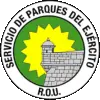
On a field of azure (blue), an emblematic gold fortress masoned in sable (black), with three wavy silver triangles at the base.
A silver border charged with eight red roosters, three in chief, two on each flank, and one on a puma.
The wavy silver triangles on a field of azure (blue) signify the movement of the sea.
The fortress represents the lineage's stature and dominion, as well as the safeguard and refuge for its troops. The Santa Teresa Fortress was built by the Kingdom of Portugal, by order of Lieutenant General Gómez Freire de Andrade, Count of Bobadela, to defend the border in this part of America granted to them by the Treaty of Pans of 1750.
This treaty extended the border further south than the present-day town of Castillos, thus causing the Kingdom of Spain to lose all the territory that drained into Laguna Merín, which today comprises almost the entirety of the Departments of Rocha, Lavalleja, Treinta y Tres, and Cerro Largo.
The cornerstone was laid on October 6, 1762, and the fortress was named Santa Teresa, after the saint to whom the Count of Bobadela was particularly devoted.
The bold rooster (right leg forward) symbolizes vigilance and tenacity in the fight. Due to its characteristics, it is considered the most representative animal for protecting the park's ecosystem in its entirety.
Motto
The motto is displayed on a scroll traditionally placed at the base of the shield.
It bears the official name: "SERVICIO DE PARQUES DEL EJÉRCITO".